

Overview
Chatbase’s Email integration enables your AI agent to automatically respond to customer emails, providing instant support directly through your company’s email system. Setup takes a few minutes and gives you AI-powered email automation across your organization.What you can do:
Have routine email support answered the moment it arrives, in your brand’s voice, with your team notified the instant delivery goes wrong.
Before you start
- Create a Chatbase account and build your AI agent
- Configure your email domain in Email settings with proper authentication (DKIM, SPF, forwarding)
- Have an active Chatbase AI agent ready for deployment
How Email integration works
The integration lets your AI agent monitor and respond to incoming emails through your configured addresses:- Email reception: Incoming emails are forwarded to your Chatbase AI agent
- AI processing: The AI agent analyzes the email content and determines the appropriate response
- Automated reply: The AI agent generates and sends a contextually appropriate response
- Delivery monitoring: The system tracks delivery and alerts you of any issues
This loop pauses when your AI agent escalates by creating a Zendesk ticket. The AI agent stops replying to the email thread, your team answers from Zendesk, and the AI agent resumes once the ticket is Solved or Closed. See Email handover with Zendesk.
How to connect Email
1
Open your Chatbase AI agent
Navigate to your Chatbase dashboard and select the AI agent you want to integrate with email.
2
Configure your email domain
Navigate to Settings → Email and follow the domain configuration process. See Email settings for detailed instructions.
Verify all configuration steps are complete before proceeding. Email addresses with configuration issues will display warnings.
3
Enable the Email channel
- Navigate to Channels → Email.
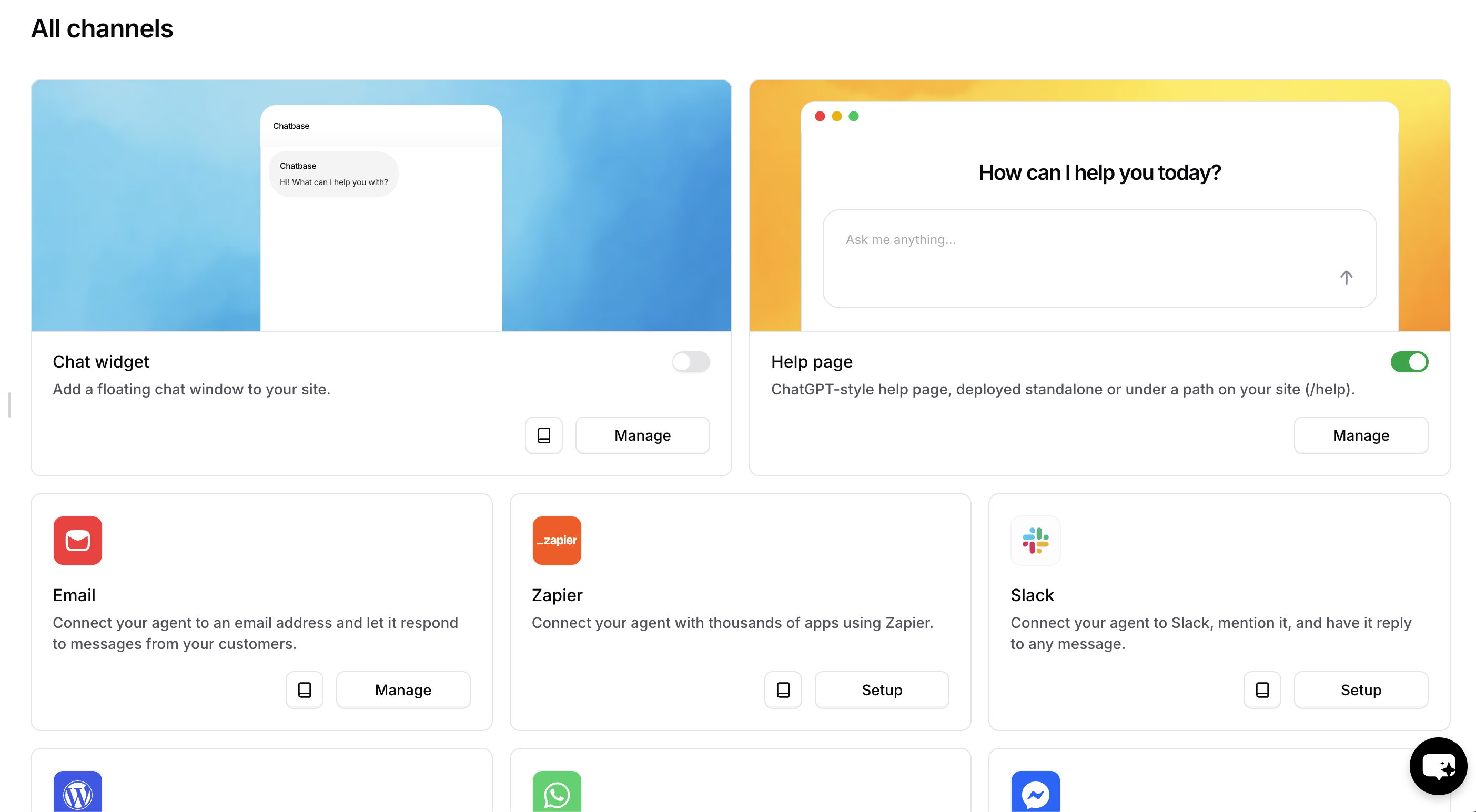
- Click Manage to access email deployment settings.
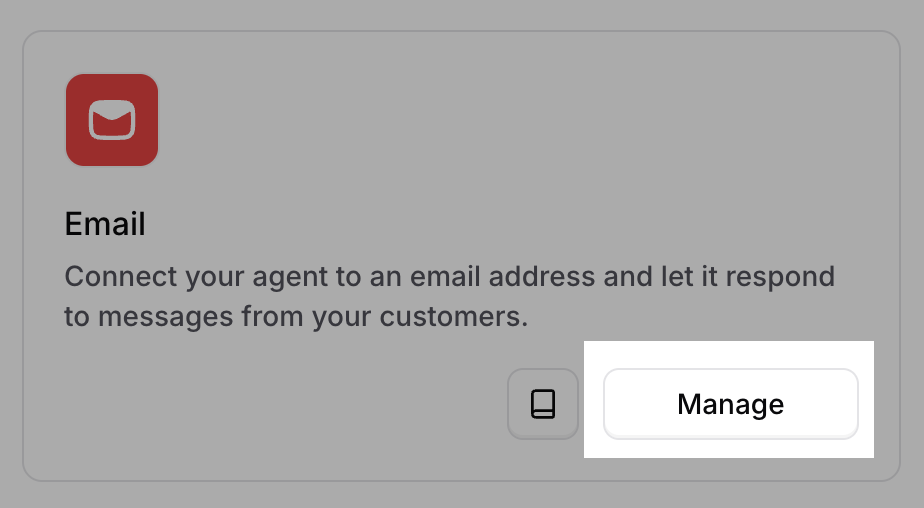
- Click Deploy and toggle the channel to Enabled.
4
Customize email settings
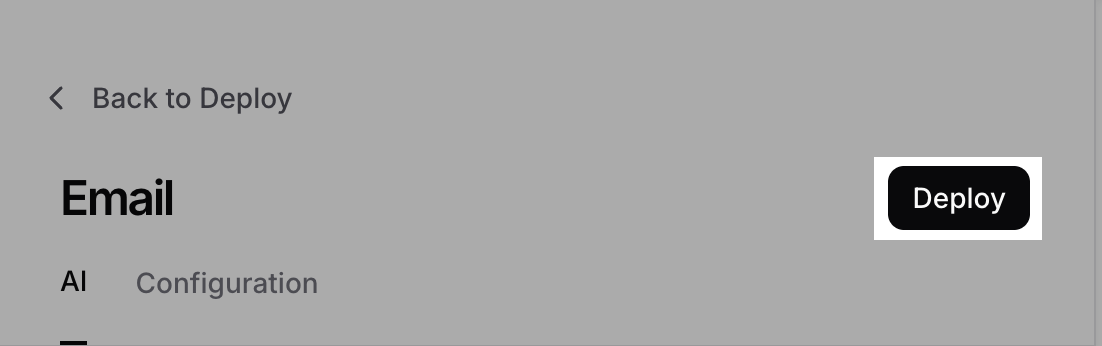
Configure your AI agent’s email behavior and appearance from Channels → Email → Manage. See Settings below.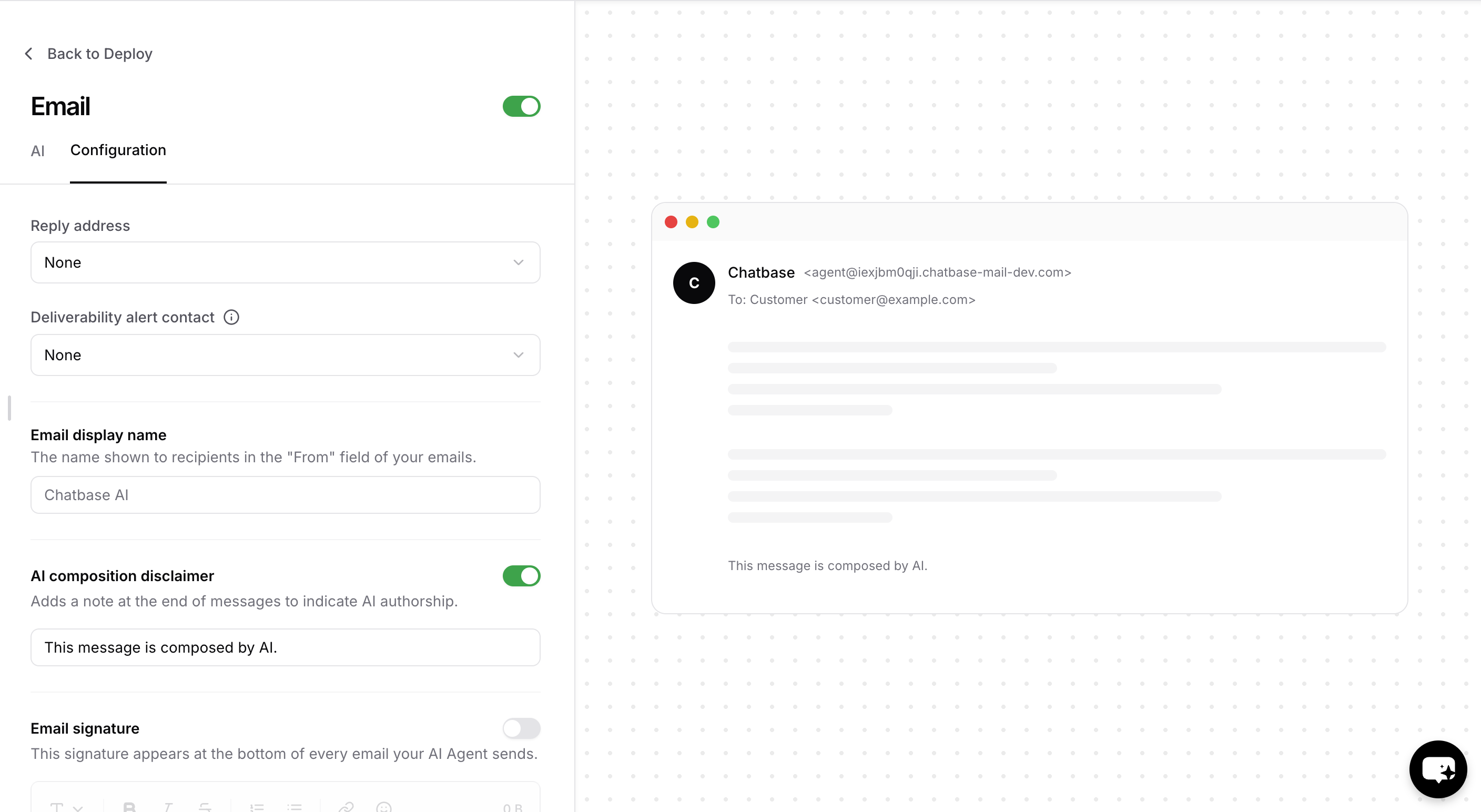
Send an email to your configured address and confirm your AI agent replies, with the display name and signature you set.
Settings
Customize how your AI agent sends and formats emails to match your brand and communication standards.Reply Address
Select which configured email address appears as the reply-to address for AI-generated emails.Configuration
Choose from your verified email addresses. Addresses with configuration issues (forwarding, DKIM, or SPF not enabled) display warnings, and you won’t be able to select them.
Deliverability Alert Contact
Designate a team member to receive notifications about email delivery failures and issues.Monitoring
Select from your account members, or choose “None” to disable delivery alerts.
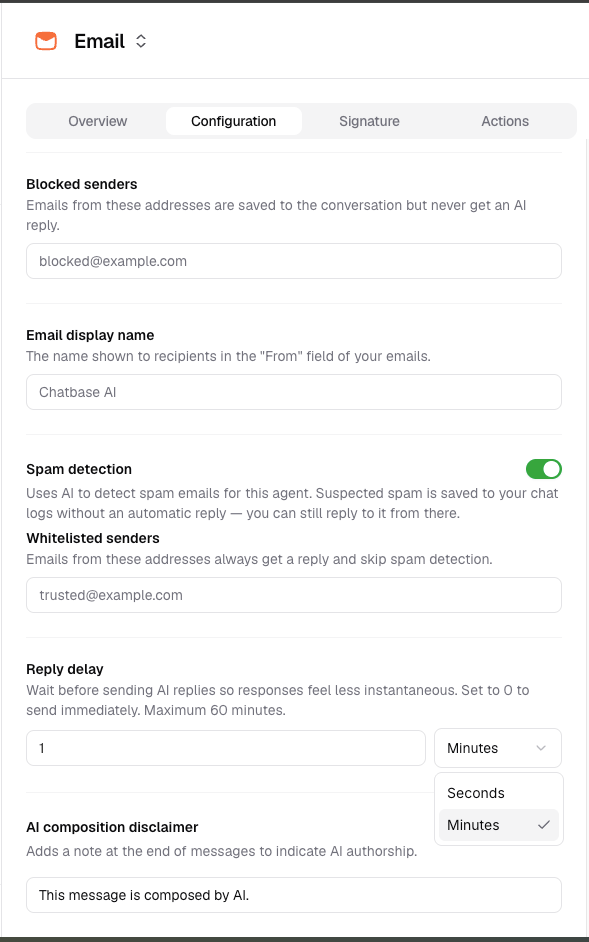
Blocked senders
Add email addresses that should never receive an AI reply. Emails from blocked senders are still saved to your conversations.Email Display Name
Set the sender name recipients see when they receive emails from your AI agent.Branding
This name appears in the “From” field and represents your brand identity in customer communications.
Spam detection
Enable Spam detection to use AI to identify suspected spam. Suspected spam is saved to your conversation logs but doesn’t receive an automatic AI reply. You can still reply to these conversations manually.Whitelisted senders
Add email addresses that should always receive an AI reply and bypass Spam detection.Reply Delay
Hold each AI-generated reply for a set time before it’s sent. An instant response can feel automated; a short delay makes replies read like they came from a person, and gives your team a window to step in before an email goes out.Pacing
Enter a duration and choose seconds or minutes. The maximum delay is 1 hour. Set it to 0, or leave it empty, to send replies immediately.
- The AI agent composes its reply as soon as the customer’s email arrives, but the send is held for the configured time.
- While a reply is waiting, it appears in your conversation logs as a pending message with a countdown.
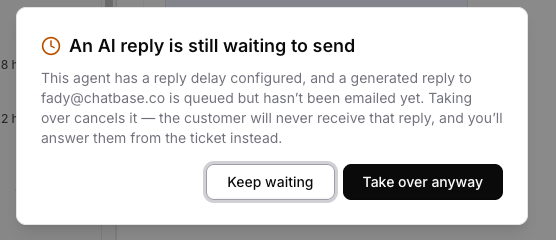
- Taking over the conversation cancels any waiting replies. You’re warned first, and if you proceed the customer never receives them and the unsent drafts are removed.
The delay applies only to automatic AI replies. Replies your team sends from the Helpdesk, and spam conversations you release manually with Reply anyway, are always sent immediately.
AI Composition Disclaimer
Add transparency by including a disclaimer that identifies AI-generated content.Transparency
When enabled, adds a customizable disclaimer at the end of emails. The default is “This message is composed by AI.”
Email Signature
Create a signature that appears at the bottom of all AI-generated emails.Customization
Supports rich text formatting including multiple lines, links, styling, and contact information.
Remove Powered by Chatbase branding from your emails by purchasing the white-label add-on. See Pricing for details.
Common use cases
- Customer support automation: Handle common inquiries and FAQs automatically
- Employee self-service: Answer HR, IT, or administrative questions instantly
- Lead qualification: Screen and respond to sales inquiries with relevant information
- Appointment scheduling: Assist with booking and calendar management
- Order status updates: Provide shipping and order information on demand
Limitations
- A configured company domain is required. Email won’t function until forwarding, DKIM, and SPF are set up, and a personal email address can’t be used.
- The reply delay caps at 1 hour.
- Taking over a conversation cancels queued replies. Anything waiting to send is discarded.
Next steps
Email settings
Configure your domain, authentication records, and verified sending addresses.