Top 5 Customer Support Chatbot Builders in 2025

Fares Elhelali
11 min read
Customer support is crucial for any business, but managing high volumes of customer inquiries efficiently can be extremely challenging without the right tools. This is where customer support chatbots come in. These automated tools can engage with customers in natural conversation, understand their issues, and resolve problems independently or route them to the right agents. With many options available today, businesses need help identifying the best chatbot platforms to meet their customer support needs.
We've compiled the top 5 customer support chatbot builders businesses should consider in 2025 based on key criteria including capabilities, ease of use, integration options, and pricing. Whether you need an enterprise-grade solution or a simple bot to start small, this review highlights the standout options available to transform your customer service.
1. Intercom
Intercom has positioned itself as the leading AI-first customer support platform, largely thanks to its Fin AI Agent. Rather than just bolting AI onto an existing help desk, Intercom has built its entire platform around the idea of AI and human agents working together seamlessly.
Fin AI Agent is powered by a proprietary AI engine specifically engineered for customer service. It learns from your help center articles, internal documentation, PDFs, and web pages, then uses that knowledge to resolve customer questions accurately. The results are impressive: Intercom reports an average resolution rate of around 41%, with some companies hitting 50% or higher. Fin supports conversations in over 45 languages, handles voice and image-based queries, and can execute multi-step actions like processing refunds or updating account details through configurable procedures.
What makes Intercom stand out beyond Fin is the full customer service suite that surrounds it. You get a unified inbox, AI-powered ticketing, automated workflows, proactive messaging, and detailed analytics across both AI and human conversations. When Fin can't resolve something, it escalates to your human team with full conversation context.
Pros
- Fin AI Agent resolves a significant portion of customer queries without human intervention, available 24/7 in 45+ languages.
- Seamless escalation to human agents with full context preserved.
- Deep integrations with over 350 apps including Salesforce, Stripe, Jira, and Zendesk.
- Comprehensive analytics covering AI and human agent performance.
- Multimodal support including voice, image recognition, and text.
Cons
- Pricing can add up quickly. Fin charges $0.99 per resolution, and seat-based pricing for the full suite starts at a premium.
- The breadth of features creates a learning curve for new teams.
- Best suited for teams that can invest time in setup and content optimization.
Best for: Mid-size to enterprise teams with high support volumes who want a fully integrated AI-first customer service platform.
2. Zendesk AI
Zendesk has been a staple in customer support for years, and its AI capabilities have caught up significantly. Zendesk AI agents can now resolve tickets autonomously, pulling answers from your existing help articles and knowledge base. If you're already running your support operation on Zendesk, adding AI is a natural extension rather than a platform migration.
The strength of Zendesk is its mature ecosystem. Email, chat, phone, social media, and WhatsApp all flow into one unified agent workspace. The reporting and analytics are production-ready, giving you detailed insights into resolution rates, response times, and customer satisfaction scores. Zendesk's knowledge base is well-integrated, so if you already have solid documentation, the AI can leverage it immediately.
Zendesk AI charges $1.00 per automated resolution, similar to Intercom's pricing model. The platform is best suited for organizations that are already invested in the Zendesk ecosystem and want to layer AI on top of their existing workflows rather than ripping and replacing.
Pros
- Seamless integration with the existing Zendesk support ecosystem.
- Omnichannel support across email, chat, phone, social media, and WhatsApp.
- Mature ticketing system with robust reporting and analytics.
- AI agents pull from your existing knowledge base with minimal additional setup.
- Enterprise-grade security and compliance features.
Cons
- AI resolution pricing ($1.00 per resolution) can scale up quickly at high volumes.
- The platform can feel complex and heavy for smaller teams.
- Advanced AI features and automation are locked behind higher-tier plans.
Best for: Companies already using Zendesk that want to add AI-powered automation to their existing support infrastructure.
3. HubSpot
HubSpot has established itself as a versatile sales, marketing, and CRM platform, and its AI-powered customer support chatbot comes included with HubSpot Service Hub plans. With seamless integration into the HubSpot ecosystem, an easy drag-and-drop builder interface, and AI capabilities powered by its Breeze AI engine, HubSpot's chatbot makes an appealing choice, especially if you already use other HubSpot products.
HubSpot's chatbots are good at handling straightforward support queries, routing conversations to the right team, and collecting lead information. The tight CRM integration means every chatbot interaction is automatically logged against the customer's record, giving your team full context. The bot builder itself is intuitive and accessible to non-technical users.
The main catch is pricing. While you can create a basic bot for free, accessing the full suite of features that make HubSpot's chatbots genuinely useful within the broader CRM ecosystem requires upgrading to higher-tier Service Hub plans, which can get expensive quickly.
Pros
- Seamless integration with HubSpot's CRM, marketing, and sales tools.
- Intuitive drag-and-drop bot builder accessible to non-technical users.
- Every chatbot interaction is automatically logged in the CRM.
- Free tier available for basic chatbot functionality.
- AI capabilities through HubSpot's Breeze engine for better comprehension.
Cons
- Making the best use of HubSpot's chatbots requires upgrading within HubSpot's product line, which can be very expensive.
- Complex pricing model that starts simple but escalates as you add capabilities.
- The chatbot is a feature within a larger CRM, not a dedicated chatbot platform.
Best for: Existing HubSpot customers who need a customer support chatbot integrated into their CRM, and businesses with a considerable budget that need a full suite of customer engagement tools.
4. Tidio
Tidio is a customer support chatbot platform that's built with small to mid-sized businesses in mind. It combines live chat, AI chatbots, and a ticketing system in one clean, straightforward interface. What makes Tidio appealing is how quickly you can get started. The setup process is simple, the bot builder is intuitive, and you can have a working chatbot on your website within minutes.
Tidio's AI chatbot, Lyro, uses natural language processing to understand and respond to customer queries based on your support content. It can handle FAQs, recommend products, and collect customer information. For businesses that don't need the complexity of enterprise platforms like Intercom or Zendesk, Tidio offers a practical and affordable alternative.
The platform also offers a genuinely useful free tier, which makes it easy to test before committing. Paid plans are reasonably priced, making Tidio one of the most accessible options for businesses that are just getting started with AI-powered customer support.
Pros
- Very easy to set up and use, even for non-technical users.
- Affordable pricing with a functional free tier.
- Lyro AI chatbot can handle FAQs and common queries effectively.
- Clean, well-designed interface that's not overwhelming.
- Multichannel support including website chat, email, and Messenger.
Cons
- AI capabilities are more limited compared to enterprise platforms like Intercom or Zendesk.
- Not ideal for businesses with complex support workflows or high-volume operations.
- Fewer integration options compared to larger competitors.
- Advanced features are locked behind higher-tier plans.
Best for: Small to mid-sized businesses looking for an affordable, easy-to-use customer support chatbot that they can set up and manage without a dedicated support ops team.
5. Chatbase
Chatbase takes a different approach from the other platforms on this list. Rather than being a full help desk or CRM with a chatbot built in, Chatbase is a dedicated AI chatbot builder that lets you create a custom AI agent trained on your own data and deploy it wherever your customers are. It supports a wide range of leading AI models from providers including OpenAI, Anthropic, Google Gemini, DeepSeek, and Meta, giving you the flexibility to choose the best model for your use case.
What makes Chatbase stand out is the combination of simplicity and power. You can have a fully trained chatbot up and running in minutes, without writing a single line of code. Upload your documents, crawl your website, connect Notion, or manually add Q&A pairs, and Chatbase builds a chatbot that actually knows your business. From there, you can embed it on your website, connect it to WhatsApp or Slack, or integrate through the API.
Chatbase also gives you granular control over your chatbot's personality, tone, and behavior, so it can match your brand voice. The analytics dashboard provides continuous feedback on performance, and the platform is built to scale, handling high volumes without disruption.
Pros
- Extremely easy to set up. You can have a trained chatbot live in minutes with no coding required.
- Supports multiple leading AI models (OpenAI, Anthropic, Gemini, DeepSeek, Meta) so you're not locked into a single provider.
- Flexible data training through file uploads, website crawling, Notion integration, and manual Q&A pairs.
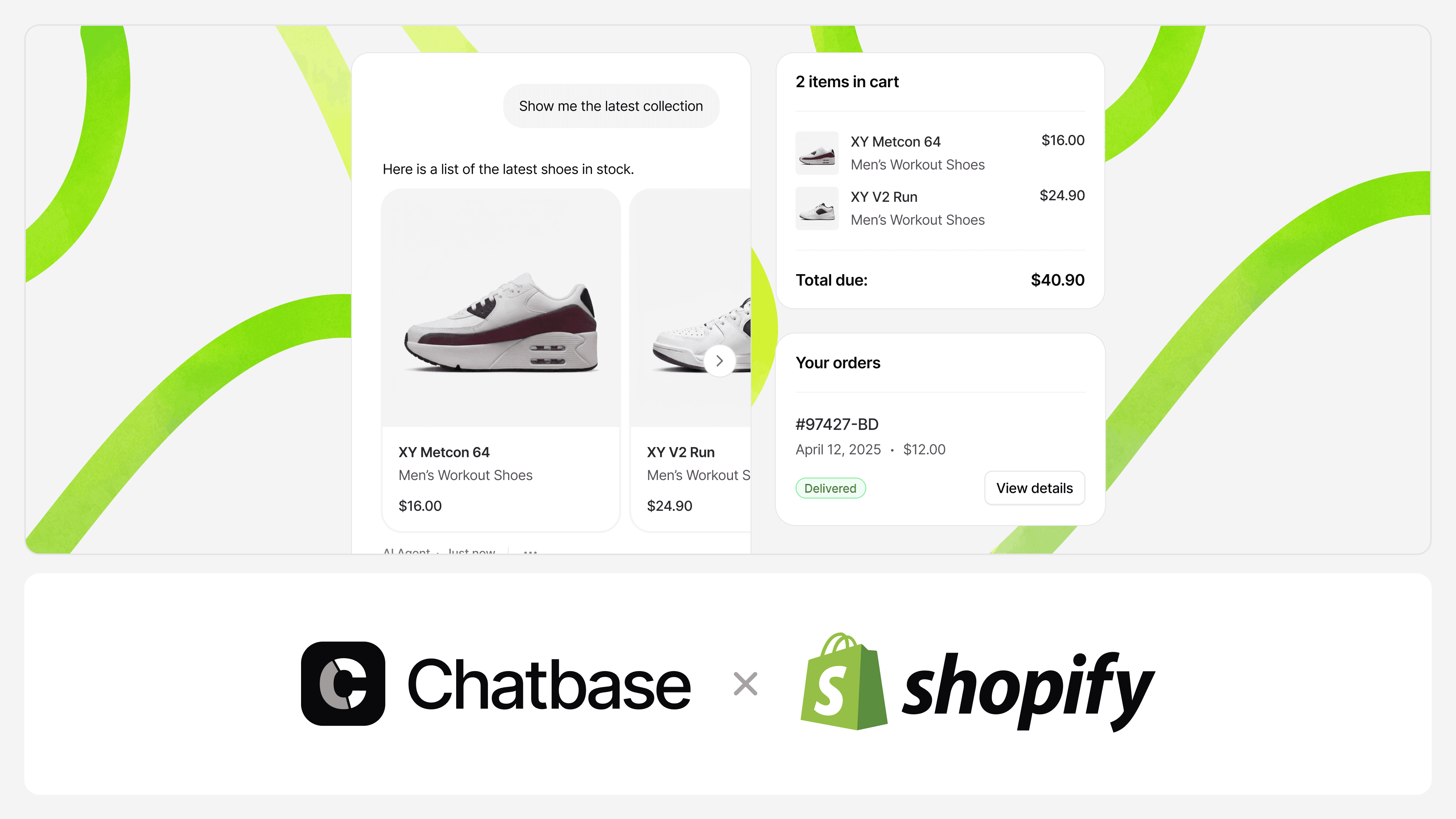
- Deploy anywhere: website embed, WhatsApp, Slack, WordPress, Shopify, and more.
- Budget-friendly pricing with a free plan to test before committing.
- Rich customization options for branding, personality, and conversation behavior.
- Granular analytics dashboard for monitoring and optimizing chatbot performance.
Cons
- Not a full help desk or CRM. Chatbase is a chatbot builder, not a complete support platform.
- Best suited as a standalone tool or complement to your existing support stack.
Best for: Small, medium, and large businesses looking for a budget-friendly, easy-to-use AI chatbot builder that can be trained on their own data and deployed across multiple channels quickly.
Why You Should Choose Chatbase
With the options on the table, it might be hard to decide which customer support chatbot builder would better serve your needs. Here's why Chatbase is worth serious consideration:
Budget-friendly pricing. Whether you're a startup or a large enterprise, Chatbase offers plans that fit your budget. Paid plans are reasonably priced, with a flexible model for extra credits and features. There's also a free plan to help you test things out before committing.
Easy to set up and use. Complex chatbot builders tied to heavy CRM systems can be overwhelming and time-consuming. With Chatbase, everything is built around simplicity. With a few clicks, you can set up a chatbot and begin automating your customer support operations in minutes. It has everything you need without the burden of dozens of components you may never use.
Powered by the best AI models available. Chatbase supports a wide range of leading AI models from OpenAI, Anthropic, Google Gemini, DeepSeek, Meta, and more. This gives your chatbots advanced natural language processing and comprehension capabilities. They can understand complex conversations and handle a vast array of customer support scenarios.
Rich integration and deployment options. Chatbase bots can be embedded into almost any type of website, from WordPress to Shopify to Squarespace and more. You can also integrate with communication channels like Slack, WhatsApp, and others.
Rich customization options. With deep customization, you can create chatbots that are tailor-made for your brand and your business. Match your brand colors, use your company logo, and make conversations align with your brand's voice.
Start building your chatbot now!
Share this article: